
Note: identifying details in this example have been anonymized, including vessel identity, exact position, voyage details, and raw sentence values.
Yes.
GNSS can be degraded even when the receiver reports 40 satellites.
That sounds counterintuitive, because satellite count is one of the first numbers people look at when judging whether a GNSS solution is healthy. A high count feels reassuring. So does low HDOP. So does a differential fix mode.
But those fields do not prove that the navigation output is safe to use.
They only describe part of the receiver state.
TL;DR
In this case, the receiver reported a strong-looking GNSS solution:
- roughly 40 satellites
- low HDOP
- 3D/DGPS-style fix metadata
- steadily advancing timestamps
But the navigation behavior was not trustworthy:
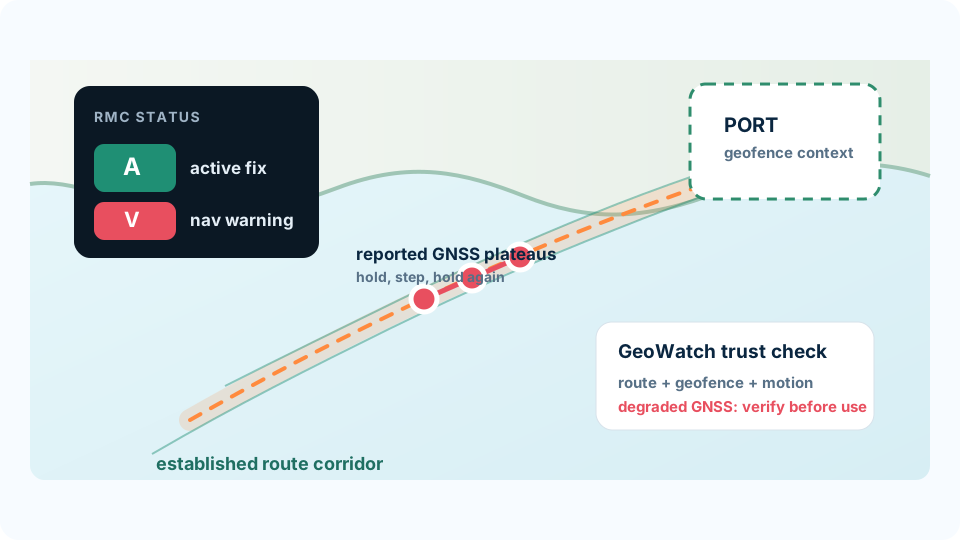
- RMC carried a final navigation-warning status
- speed over ground was almost always
0.00 kn - course over ground jumped wildly while speed was near zero
- position repeated in sticky plateaus, then moved in small steps
- onboard motion context showed low vessel motion
That is not a clean spoofing verdict.
It is a degraded GNSS integrity case.
The Trap: Course Over Ground at Zero Speed
Course over ground is only meaningful when there is actual movement over the ground.
When speed over ground is near zero, COG can become noise.
A stationary or nearly stationary GNSS receiver may report course values that jump from one direction to another even though the vessel has not made a real turn. That can look dramatic in downstream analytics if the system treats those heading changes as physical motion.
But at 0.00 kn, the receiver is not measuring a meaningful direction of travel.
It is mostly reporting the direction of tiny position jitter.
That means a dramatic-looking course change at zero speed should be handled with caution. It may be useful context, but it is not strong evidence of spoofing unless another independent signal confirms real movement or deception.
What Was Strong Evidence
The stronger signal was not the COG jump.
The stronger signal was sentence-level contradiction.
The receiver was saying several things at once:
- RMC looked active
- RMC mode suggested differential GNSS
- the final RMC navigation-status field was warning
- GGA and GSA still looked healthy
- position output was sticky and stepped
- speed was almost always zero
That combination means the GNSS data should not be trusted as ordinary vessel movement.
It does not automatically prove spoofing.
It does prove degradation.
Why 40 Satellites Did Not Save It
Satellite count is useful, but it is not integrity.
Low HDOP is useful, but it is not integrity.
A differential mode is useful, but it is not integrity.
A receiver can have a strong sky view and still output navigation data that is stale, inconsistent, flagged, or physically implausible.
That is the uncomfortable part: the dashboard can look healthy while the navigation stream is already warning you not to trust it.
The Better Classification
For this case, the cleaner classification is degraded GNSS.
Spoofing can remain a suspicion if other evidence later supports it. But it should not be promoted just because course over ground jumps while speed over ground is effectively zero.
The Takeaway
GNSS integrity is not a single field.
It is the agreement between fields.
If satellite count, HDOP, and fix mode look strong, but navigation status is warning, position is sticky, speed is zero, and course is jumping, the right conclusion is not "everything is fine."
The right conclusion is:
The GNSS solution is degraded, even with 40 satellites.